
How would you like one exercise that strengthens the chest, arms, shoulders, back, stomach and leg muscles? In my humble opinion, the push-up is the best darn exercise invented by man. It doesn’t require any equipment, can be done anywhere, works virtually every muscle group in the body with variations, improves posture and, unless you have a major shoulder or elbow issue, can be done by anyone at any age.
If you don’t do anything else to build strength, do the push-up. Two scientific studies (references below) provide interesting information that shed light on why the push-up is a great exercise and help us build workouts that maximize the push-up’s effectiveness.
Study #1. Kinetic Analysis of Several Variations of Push-ups by B. Wurm et al. In layman’s terms, the study estimates the percentage of body-weight being “pushed-up” based on the variation of the push-up. For example;
• The regular push-up is equivalent to pushing about 64% of body-weight.
• With feet elevated 24 inches – 74%
• With feet elevated 12 inches – 70%
• On bent knees – 49%
• With hands elevated 12 inches – 55%
• With hands elevated 24 inches – 41%
So, for a 170-pound person, the amount of force ranges from 70 pounds with hands elevated 24 inches to 126 pounds with feet elevated 24 inches.
Study #2. Another study, Effect of the push-up exercise at different palmar width on muscle activities by Kim et al., found that hand placement increased (or decreased) the activity of the various muscles worked in the exercise. For example, by moving the hands outside shoulder width during the push-up, activity was increased significantly in the bicep and the serratus anterior (outside chest).
By placing the palms on the inside during the push-up, activity increased significantly on the pecs (chest), the triceps, and especially the infraspinatus (the largest of the four rotator cuff muscles).
The delts (shoulder-front) and lats (back-sides) did quite nicely with the neutral position and did not change much with any variation.
You decide if, and when you want to use the study findings. For now, decide where you want to start your push-up program. Just be sure you feel comfortable and safe.
Before you start. All variations will put pressure on shoulders, chest, arms, elbows, wrist, toes, back. Do an honest assessment of the condition of these body parts. Any serious problems with health, especially in these areas, talk to your doctor.
• Set goals. What do you want to accomplish? One good push-up. Maybe just a few push-ups every day is enough. Strengthen core, arms? 50-100 per day? One-arm push-ups? Hold planks for some period of time?
• Set a plan, or not. A plan might be to do as many as you feel like. Or it might include frequency of exercise, exercise position changes, sets, repetitions.
• Warm-up. Loosen up entire body; shoulders, hands, back, legs, etc. 3-5 minutes should be enough. In your first set, do 5 to 10 push-ups of the target variation to alert the muscles as to what is coming.
• Other rules. Wear comfortable clothing, good running/walking shoes. Hydrate. Use an arm/elbow/wrist support if necessary. Rest 2-3-minutes in between sets. Make sure the platform you are using is sturdy and immovable.
Regular push-up. The regular push-up is the ultimate target. How many sets and repetitions are up to the individual. The regular push-up also provides the model for form. In all variations of the push-up, the body is kept straight from head to toe (except for Knee push-ups, of course).
1. To do a regular push-up, start with hands in an extended position and toes on the floor and with hands and arms at shoulder width (or slightly outside shoulders) and directly below the shoulders.
2. Use good athletic shoes. You don’t want to injure your toes. Do this on carpet or a mat until you are comfortable.
3. Keep the entire body in a straight line, no sagging. 
4. Breathe in and lower yourself at a controlled pace keeping your back and legs straight. Stop about 2–3 inches before your chest (or your stomach if that’s the part that hits first) gets to the floor. 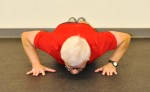 5. Push up until arms are fully extended, breathing out as you go up.
If you progress a little each day, say by one push-up or better form, you should be able to do 15–20 good ones in a month or two. As in any exercise, form is important, both to avoid injury and get the most benefit.
If you aren’t ready to try the regular push-up, choose one of the following as your starting point and progress through each successive level until you are satisfied. At each level, work up to three sets of ten repetitions, then try the next phase. If it’s too easy, promote yourself to the next phase.
Wall as platform. This is basic but will get one used to the movement without putting much pressure on the elbows or shoulders. Stand two to three feet from a wall and with hands straight out from shoulders, conduct the push-up (or in this case, push-out) motion.
Bar (e.g. on Smith Machine at gym) at 36-42 inches (or counter or back of sofa) as platform.
Bar at 24 inches (or footstool about 18 inches) as platform.
Bar at 12 inches. (or sturdy box)
Plank. The plank (hand or forearm) is different than a push-up in that it is a purely isometric exercise, but a good way to strengthen the arms and the core. Simply get into the regular push-up position and hold that position or modify by supporting the body with forearms on the floor. Hold that position as long as possible and, if you are enjoying it, keep adding time. I have a friend, similar in age, who held the forearm position for 13 minutes. If it’s too easy, elevate your feet.
Knee push-up. These were called girl push-ups back when. I find them harder than regular push-ups due to the balancing one must do for correct form.
Regular push-up. See above.
Okay, you succeeded and can just stay with the regular push-up, increasing reps and moving palm placement to work a variety of muscles. Or you can move on to more variations, increasing the load.
Push-up with feet elevated 12 inches. Gyms usually have boxes or platforms of various sizes. If you are at home, find a sturdy box or stool.
Push-up with feet elevated 24 inches. At home, use an ottoman or sofa. If you are doing 25-plus of these, you are probably ready to try push-ups with hands on an unstable surface or using a TRX suspension system. See “More Variations” below.
Frequency and rest. Can you do push-ups every day, or should you wait 48 hours as with most weight-bearing exercises? There are varying opinions. Some say push-ups do not break down muscle like heavy weights and point to military training where they may do a couple hundred every day. Since this article is aimed at 50-plus-year old’s, use some caution. If you are in an advanced stage of push-ups where you may be breaking down some muscle, maybe the 48-hour rule is the way to go. If you are just beginning, go slowly and let your body tell you what it can do. You don’t want your progress to suffer due to even a small self-imposed injury.
More difficult variations. If you want to complicate the push-up or add more focus on balance, try them with hands on a Swiss Ball or using a TRX. The TRX is a trademarked system originally used by Navy Seals as a portable gym. You probably shouldn’t try the TRX without instruction unless you are well advanced in your workouts and have at least perused their website, https://www.trxtraining.com/. Another variation of the push-up is to place your hands-on dumbbells instead of the floor to add to the range of motion. Be careful not to strain the shoulder on this one by going too low. If these are too easy, you can always try one-armed push-ups. Good luck with that.
There is no end in the variations of push-ups that will tax your strength and balance. Just make sure you add the push-up to your routine.
References.
Kinetic Analysis of Several Variations of Push-ups by B.Wurm et al https://ojs.ub.unikonstanz.de/cpa/article/viewFile/4457/4146
Effect of the push-up exercise at different palmar width on muscle activities by Kim et al https://www.ncbi.nlm.nih.gov/pmc/articles/PMC4792988/
This article was extracted and modified from Finishing Strong! Strength Training for Old(er) Guys by Ron Marinella. The paperback and eBook are available at Amazon.com. http://www.amazon.com/dp/099934900
 Finishing Strong! Strength Training for Old(er) Guys